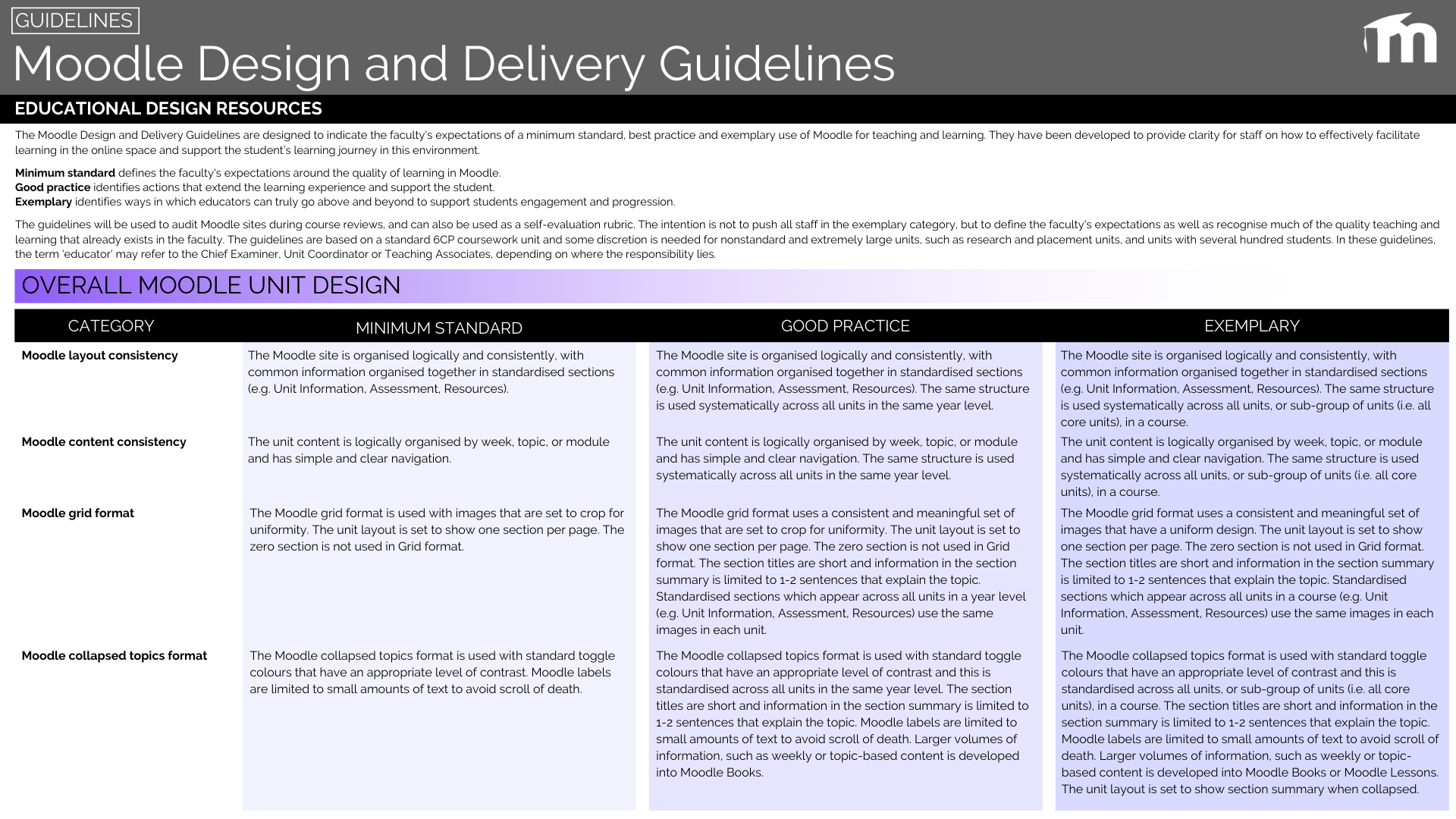
When I started at my current institution, I found there was a need for an evidence-informed document to help educators achieve the targets of the new education strategy and improve the use of the virtual learning environment, Moodle. So, I developed the MNHS Blended and Online Guidelines (first iteration). I evaluated the current literature in online learning pedagogy and completed an environmental scan of Australian University guidelines to ensure the document was current, evidence-informed and aligned with professional practice standards in Australian Universities. I presented the guidelines at the faculty Learning and Teaching Committee, where senior faculty members agreed that staff needed standards for using the virtual learning environment. I set the document as a framework for all support related to educational technology and online pedagogy and promoted Educational Design work that aligned with the guidelines. I then developed a quality assurance audit tool based on the guidelines that would allow me to evaluate the use of the virtual learning environment across the faculty. I proceeded to complete an initial diagnostic audit of 14 courses comprising 100 individual Moodle units, and detailed recommended changes to enhance the units across a course. From 2019 to 2021 I audited a further 42 units across 6 courses during the course review process. In 2021, after four years of extensive use, I re-evaluated guidelines in line with current literature and University standards and revised the guidelines to include three separate standards and created the Moodle Design and Delivery Guidelines. The guidelines were adapted to be used as a Moodle audit tool and this is used to evaluate course Moodle sites during course review.


I wanted the process to be one of continual communication and improvement between the Educational Designers and the course teaching teams. What eventuated was a meeting with the Course Coordinator that was often met with resentment followed by a lack of communication. I realised that the approach, as supportive as its intention has been, was received negatively. I took a step back and reflected on the existing quality assurance processes at the University, and determined that this was just one more process to follow, and not a mandatory one. I also recognised that schools within the faculty have their own politics, policies, demands and red tape, and it can be difficult to navigate these issues as an external party. I concluded that the process had to be encapsulated within an existing quality audit process to gain more traction. The Course Review Procedure is a highly formalised and structured process that involves many senior staff across the faculty and centrally. I decided there would be a greater incentive to change if the Moodle audit was included as a feedback mechanism in the course review process. In a course review, faculty educators are often overwhelmed by the volume of feedback and don’t always have access to support staff to help them with how to develop the course based on that feedback, so I was perfectly positioned to offer the support in their time of need. This greatly improved my positioning across the faculty as a trusted expert, as few others were capable of offering the same kind of support. There was a much greater uptake of support, predominantly through individual consultations and Educational design workshops.
The most successful example of impact from this process came from a single course review in 2019. The feedback process with the Course Coordinator led to several educators within the team attending all Educational Design workshops available at the time, along with extensive uptake in individual consultations for assessment and course design feedback. In line with this, all units within the course were fully revised, including improving the design, information and navigation of the virtual learning environment, as well as significant improvements to the constructive alignment of the unit content, assessment tasks and activities of the unit learning outcomes.
Another example of impact was that of the uptake of the guidelines outside the faculty. Intending to lead the Educational Design Community of Practice towards greater collaboration, I shared the guidelines, process and quality audit tools with the group. This gained the attention of the Educational Design team within the Faculty of Business and Economics, where they tailored the guidelines to their faculty context and continue to use the same audit process to this day. I intended to transform the collaborative capacity of the Educational Design Community of Practice, leading by example, to create stronger improvement across the institution as a whole.
When I revised the guidelines in 2021 I acknowledged that there was a need to amend the document to reduce any negative interpretation of the audit process. Having a pass/fail standard, which was the case in the previous audit tool, appeared to negatively gear the process. In response to this, I created three standards. First, I created a minimum standard, to identify the faculty expectations of design and delivery in the virtual learning environment. Second, I created a good practice standard to identify that many faculty educators, particularly since the course audits of 2017, have in fact been working towards this good practice by implementing changes aligned with the feedback from the Course Review quality assurance audits. Third, I created an exemplary standard, to truly showcase faculty educators that have gone above and beyond to create a consistent and engaging experience for students in the virtual learning environment.
You must be logged in to post a comment.